What Marco Pierre White Taught Me About Interior Design Philosophy

The best chefs and the best designers have more in common than you'd think. Both obsess over details nobody else notices, both let quality materials do the talking, and both know that the real magic is in the restraint.
I've been listening to a lot of Marco Pierre White recently. Not recipes. Philosophy.
The man who became the youngest chef to earn three Michelin stars, the first British chef to do it, and who then picked up the phone and gave them all back. Not because he'd lost his touch. Because he'd won. Because defending them had turned his kitchen into a machine that couldn't take risks anymore. That takes a level of self-awareness most people never reach.
But it's not the stars or the drama that's got me hooked. It's something he says over and over again, in interviews, in his book The Devil in the Kitchen, in that gravelled Yorkshire voice that makes every sentence sound like gospel:
"Mother Nature is the true artist. You're just the cook.
Let her do the work. Let the ingredients present themselves for what they are. Stop trying to be clever. Stop overcomplicating things. A fig should taste like a fig. A piece of perfectly seared beef doesn't need six foams and a micro herb garden to justify its place on the plate."

I sat with that idea for a while. And I realised he wasn't just talking about food.
An Interior Design Philosophy Born in the Kitchen
Marco talks about three things all great chefs share; they respect nature as the true artist, everything they do becomes an extension of themselves, and they give you insight into the world they were born into.
Now swap "chefs" for "designers" and read that again.
The best interior designers I've studied, the ones whose work stops you mid-scroll, whose rooms make you feel something before you've even clocked the furniture, they all share those same three qualities. They respect their materials. Their work is unmistakably theirs. And their spaces tell you something about who they are and where they come from.
That's not a coincidence. It's the same craft, expressed differently.

Marco grew up watching his Italian mother make risotto in a modest kitchen in Leeds. He watched his nonna and his aunties prepare vegetables for minestrone. He peeled potatoes because they were too poor for tins. That world, those memories, that honesty, went onto every plate he ever served. He once said that cooking is a philosophy, not a recipe. That the story is more important than the method.
Interior design works the same way. The best rooms aren't assembled from a Pinterest board. They're built from a point of view. A conviction about how a space should feel, how light should fall, how a material should age. The room tells you who designed it, not because there's a logo on the wall, but because you can feel the decisions. It's an interior design philosophy built on honesty, not trends.
Take Ilse Crawford. She once said that when she looks at making spaces, she doesn't just look at the visual. She's interested in the sensory thing, the primal perspective, the thing that touches you.

Her studio, Studioilse, approaches every project from the human experience outward. Not "what will this look like on Instagram?" but "how will this feel at 7am on a Tuesday when you're half awake and making coffee?" She grew up watching her mother add character touches to rooms. She walked around buildings as a child noticing how spaces changed people's behaviour. That childhood curiosity became a philosophy that's shaped everything from the Ett Hem hotel in Stockholm to Soho House in New York. Her interiors don't shout. They hold you. You feel the warmth of the materials before you register the design. That's Marco's kitchen philosophy translated into three dimensions: let the ingredients speak.
Then there's Adam Bray. Over thirty years in the game, started as an antiques dealer at sixteen, and that background in handling and sourcing exceptional objects runs through every room he touches.

His colour instinct comes from spending hours in museums studying how painters mixed their pigments. He's described by House & Garden as a master of impactful yet grounded interiors, and there's a reason for that: the rooms are luxurious without being precious, eclectic without being chaotic. He doesn't follow trends. He follows the material. A piece of fabric rescued from a 1960s strip-out sat in a box for twenty years before it became the basis for an entire carpet design. That's not decorating. That's a relationship with craft that most people don't have the patience for. It's the same instinct that makes a great chef hold onto a technique or a flavour memory for decades until the right dish presents itself.
Let Quality Do the Talking
Here's where Marco's philosophy really hits home for me.
He's spoken at length about young chefs who overwork their food. Who pile on techniques and garnishes to hide their lack of confidence. Who manipulate an ingredient so aggressively that by the time it reaches the plate, it's lost everything that made it special in the first place. He's blunt about it:
The more you touch the food, the more you ruin it.
I see the exact same thing in interiors.
Someone falls in love with a high-end residential project they've seen online. A beautiful room with handmade Venetian plaster walls, solid brass hardware, aged joinery in quarter-sawn oak. They want that feeling in their home. Fair enough. But then budget meets ambition and the compromises start. The Venetian plaster becomes a paint effect. The solid brass becomes a gold-sprayed copy off Amazon. The quarter-sawn oak becomes an MDF wrap oak effect.
And the room falls flat. Not because the layout is wrong or the colours don't work. Because the materials have been asked to pretend to be something they're not.
Marco would call that overworking the dish. Trying to make a cheap cut taste like wagyu with enough sauce and smoke. It doesn't fool anyone with a trained palate. And it doesn't fool anyone with a trained eye.
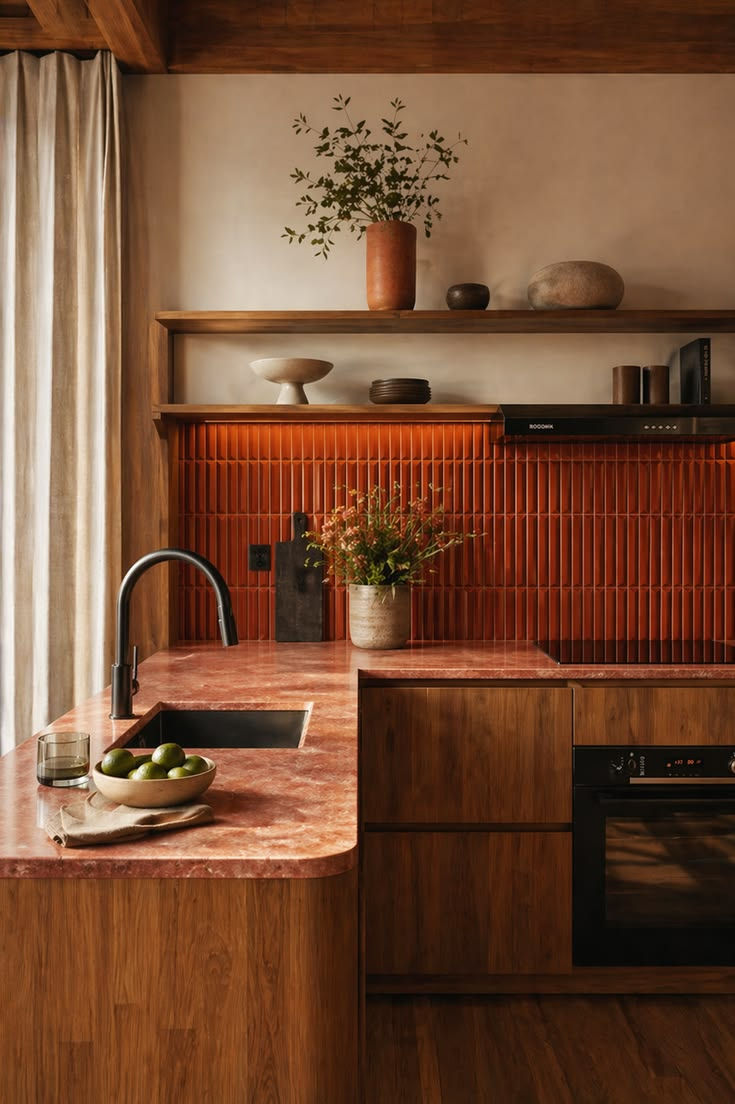
Here's the thing people miss: you don't have to use expensive materials everywhere. You just have to be honest about the ones you choose. A well-laid concrete floor has more integrity than a bad marble replica. A room painted in one beautifully chosen colour will always outperform a room crammed with trend-led "moments" that fight each other for attention.
Let the materials breathe. Let quality do the talking. Mother Nature is the artist. You're just the cook.
The Acquired Taste Problem
Not everyone can taste a broth and immediately tell it needs more acid. Or more fat. Or another ten minutes on the heat. And that's not a criticism, it's just reality. That level of palate takes years to develop. You earn it by tasting thousands of broths, by burning hundreds of batches, by standing next to someone better than you and paying attention.
Design is the same, in every field.
Someone who's spent years poring over design magazines, obsessing over twenty shades of white, agonising over whether the plain brass hinge or the black ornate one is right for that specific door on that specific wall in that specific light. That person will walk into a room and feel what's off before they can articulate it. The skirting profile is too heavy for the ceiling height. The pendant is three inches too low. The grout colour is pulling warm when everything else is pulling cool.
Nobody's born with this. It's an acquired taste. And it's earned the same way a chef earns theirs: through obsession. Through giving a damn. Through caring about the details that 99% of people will never consciously notice, but will absolutely feel.
Marco once said that most people's ambitions are greater than their abilities. That's not him being cruel. That's him being honest about what separates someone who cooks from someone who is a cook. The gap isn't talent. It's hours. It's the relentless, sometimes maddening pursuit of getting it right.
The Service: Choreography You're Not Supposed to See
Walk into a Michelin-starred restaurant and something happens before you've even looked at a menu. The room is warm but not stuffy. Someone greets you by name or by instinct. Your coat disappears. Your chair is pulled out at the right moment. The lighting makes you look better than you did when you walked in.

The sommelier appears exactly when you've finished scanning the wine list, not a second before. The waiter knows every herb in the sauce, can tell you which farm the lamb came from, and never once makes you feel stupid for asking. The plates arrive at the same time. They're cleared at the same time. The whole thing moves like a well-rehearsed play where all the performers know their positions, but none of them look like they're performing.
You're the audience. You're the main focus. Everything revolves around your experience, and the effort behind it is deliberately invisible.
A properly run interior design studio should feel exactly the same.
From the first phone call to the final reveal, the client should feel like they're the centre of the process. The designer should know their specifications inside and out. The contractor liaison should be seamless. Documentation, mood boards, samples, Visualisations, each one should arrive at the right moment, presented with clarity and confidence. No fumbling. No "I'll get back to you on that." No gaps in the choreography.
The client shouldn't have to chase updates. They shouldn't feel anxious about timelines. They shouldn't be making decisions they're not qualified to make because the designer couldn't be bothered to filter the options properly.
The whole thing should feel effortless. And behind that effortlessness? Ruthless preparation. Obsessive attention. Systems built on years of doing this and learning what goes wrong when you don't.
That's the Michelin standard applied to design.

The Thing No Algorithm Will Ever Replicate
I need to say something about AI here, because it's the elephant in every creative industry room right now.
AI can generate a room layout in seconds. It can suggest colour palettes, pull together mood boards, even render a photorealistic visualisation of a space that doesn't exist yet. I use AI tools myself. They're useful. They save time on certain tasks and I'm not precious about that.

But here's what AI will never do.
It will never walk into a room and feel that the ceiling height is fighting the proportion of the windows. It will never run its hand across a sample of linen and know instinctively that it's wrong for that particular sofa in that particular light. It will never sit with a client over coffee and read the slight hesitation in their voice when they say they "quite like" a scheme, and understand that "quite like" actually means "I absolutely hate it, but I don't want to offend you."
It will never taste the broth.
Marco's philosophy is rooted in something deeply human: the connection between a person, a material, and a lifetime of accumulated instinct. That can't be coded. A chef doesn't follow a recipe when they season a dish at the pass. They taste, they adjust, they trust thirty years of muscle memory and a palate built on ten thousand meals. A designer doesn't follow a trend report when they choose the right shade of blue for a north-facing room in Edinburgh in November. They know. Because they've been in that room before, metaphorically or literally, hundreds of times.
Ilse Crawford put it perfectly when she said that interiors are encountered through the body, not the intellect. Try teaching that to a machine.
AI can assist the cook. But it will never be the chef. And it will certainly never be Mother Nature.
I'm Not Michelin, Yet
"Chris, you can't say that! How can you expect to get any clients now?"
I'm not writing this from a three-star studio with a waiting list and a design-book on the shelf. I'm writing this from a young practice in Edinburgh that's still building. Still grafting. Still earning its reputation one project at a time.
I know that. And I'm not embarrassed by it. Because I also know this: I will get there.
Not because I'm the most talented designer in Scotland. I'm sure there are plenty who'd give me a run for my money. But because I have the obsession. The same obsession that drove a 16-year-old Marco Pierre White to leave Leeds with seven quid in his pocket and walk into a professional kitchen with nothing but nerve and a work ethic that bordered on self-destruction.
I love this game. Not the Instagram version of it. The actual, grinding, problem-solving, 1am-tweaking-a-mood-board version of it. The feeling when you hand over a room and watch someone's face change. When what they imagined was possible gets quietly demolished by what you actually delivered. That moment. That's the reason.
Marco once said that gastronomy is the greatest form of therapy any misfit could ever be exposed to. I'd argue interior design runs it close. It's a craft that demands everything from you, your eye, your patience, your ability to listen, your technical knowledge, your willingness to be wrong and fix it before anyone notices.
I'm not Michelin yet. But I know what Michelin tastes like. I know what it looks like. And every single project I take on is one step closer.
The young eager chef trying to earn his first star? That's me. Different kitchen. Same fire.
Chris is the founder of Braw House, an Edinburgh-based interior design studio. If you're planning a project and you want someone who obsesses over the details as much as you do, get in touch.you do, get in touch.



Comments